In Part 1, I introduced the AI agents behind The Quiet Path, the faith-media venture we built and operate at AWH. In Part 2, I followed one week of devotions from my Bible study to the inbox, the podcast and social posts. This time I want to talk about the part nobody puts on a slide: the plumbing.
Agents get the attention, but they are only as reliable as the systems underneath them. Our rule for those systems is simple. They should be boring, cheap and set up the same way every time. Here is what that looks like in practice.
The domain: Cloudflare Registrar, about $10 a year
The Quiet Path lives at quietpathapp.com. We registered it in September 2026 through Cloudflare Registrar, which is my preferred registrar for every domain now. It cost about $10 for the year. Cloudflare also runs the DNS for the domain, so the registration, the DNS records and the email forwarding all sit in one account.
That matters more than it sounds. When something breaks, there is one place to look. When someone else needs to help, there is one account to grant them access to, not three.
Hosting: Netlify, with the domain attached
The website is a plain static site hosted on Netlify. Netlify gave us a free address, quietpath.netlify.app, and we attached both quietpathapp.com and www.quietpathapp.com to the same site. The bare domain is the main address. Both the www version and the old Netlify address redirect to it.
That redirect turned out to be useful. Before we owned the domain, early Instagram posts and campaign images pointed at quietpath.netlify.app. Those links still work, and they land people on the real address.
Email: Cloudflare Email Routing to one agent inbox
The Quiet Path has three public addresses: devo@, support@ and privacy@ at quietpathapp.com. None of them is a mailbox. Cloudflare Email Routing forwards all three to a single agent inbox, where mail can be read and sorted. Email Routing is free, and it only forwards. It doesn't send anything, which fits our rule that nothing goes out without me.
We didn't invent this for The Quiet Path. It's the same pattern we use on our other recent projects: Cloudflare Registrar, Cloudflare DNS, Email Routing to a shared inbox and Netlify for the site. When every project is set up the same way, fixing one teaches you how to fix all of them.
The podcast: a feed file on our own site
This is my favorite piece of the stack, because it's so plain. A podcast is really just an RSS feed that lists episodes and points to audio files. Ours lives at quietpathapp.com/podcast/feed.xml, and the audio files sit on the same website. Apple Podcasts reads that feed, and The Quiet Path show is on Spotify as well.
There is no separate podcast hosting service in the middle. If we ever changed hosts, we would move a feed file and some audio, and listeners wouldn't notice.
The written devotions go out through Substack, which handles the email list and delivery. Substack doesn't charge to publish a free newsletter, and each episode is also posted there next to its written devotion.
Social: Buffer, not logins on shared machines
This is the lesson we learned the hard way. Early on, agents tried to sign in to Instagram and other Meta accounts directly from a shared computer. Meta didn't like it. We hit lockouts and endless security checks, and at one point I had to drop a project because signing in from that machine kept tripping Meta's defenses.
Now Instagram for @quietpathapp is connected to Buffer, and the agents schedule posts through Buffer's official connector. The rule now is that nobody logs in to Meta from a shared machine. The account stays connected in one place, and the agents never need my Instagram password. We started on Buffer's free plan, which allows three channels, and that limit forced us to be deliberate about which accounts mattered most.
The App Store: an API key instead of a shared password
The iOS app lives in App Store Connect. When a listing needs to change, like the subtitle update I described in Part 1, we don't share my Apple login. I created an App Store Connect API key with the App Manager role, and Forge uses that key to make listing updates through Apple's API.
A key like that is limited to what the role allows, and I can revoke it at any time without changing my own password. That's the shape I want for every system an agent touches.
The Apple Developer Program itself is $99 a year. Apple offers fee waivers to eligible nonprofits, which is worth knowing if you're a ministry.
What it costs
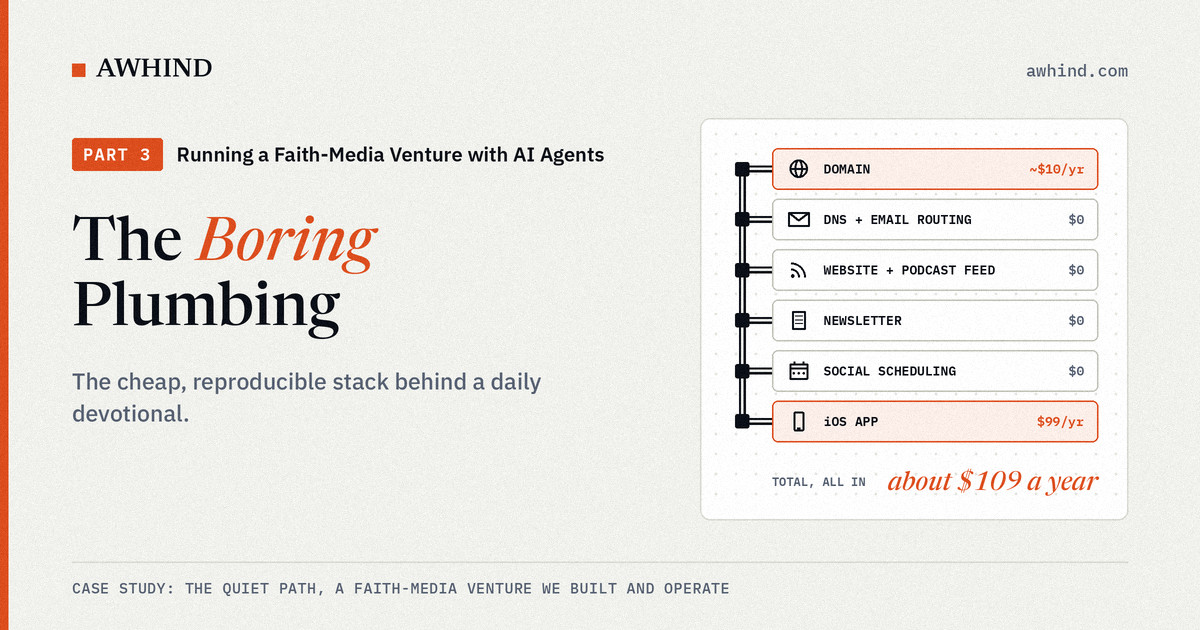
Here is the stack in one place:
- Domain: about $10 a year through Cloudflare Registrar.
- DNS and email forwarding: Cloudflare, with Email Routing at no cost.
- Website and podcast feed: Netlify, on the free plan.
- Email newsletter: Substack, free for a free newsletter.
- Social scheduling: Buffer, on the free plan.
- iOS app: Apple Developer Program, $99 a year, with fee waivers for eligible nonprofits.
None of these is a big contract. Apart from about $10 a year for the domain and $99 a year for Apple, everything here runs on a free plan.
Why boring, cheap and reproducible matters for a ministry
Cost. Ministries and small publishers answer to donors and budgets. A daily devotional shouldn't need an enterprise software bill. When the plumbing is this cheap, the money can go to people and content.
Supportability. Every tool here is common and well documented. If I'm unavailable, a volunteer, a staff member or another consultant can look at it and understand it in an afternoon. The agents benefit from the same thing: standard tools with clear rules are easier for them to operate correctly.
Not locked to one person or vendor. The ministry should own its domain. The podcast feed is a file we control, not a platform we're trapped in. Email forwarding can be repointed in minutes. API keys can be revoked and reissued. If one vendor changes its prices or terms, we can move a piece without rebuilding everything. And because every project follows the same pattern, the knowledge doesn't live only in my head.
That last point is the one I care about most. A ministry's work should outlast whoever set up the website.
Let's talk
If you lead a ministry, run communications for a church or publish devotional content on a small team, I'd be glad to help you put a stack like this in place, one you own and can afford to keep running. Email me at info@awhind.com.