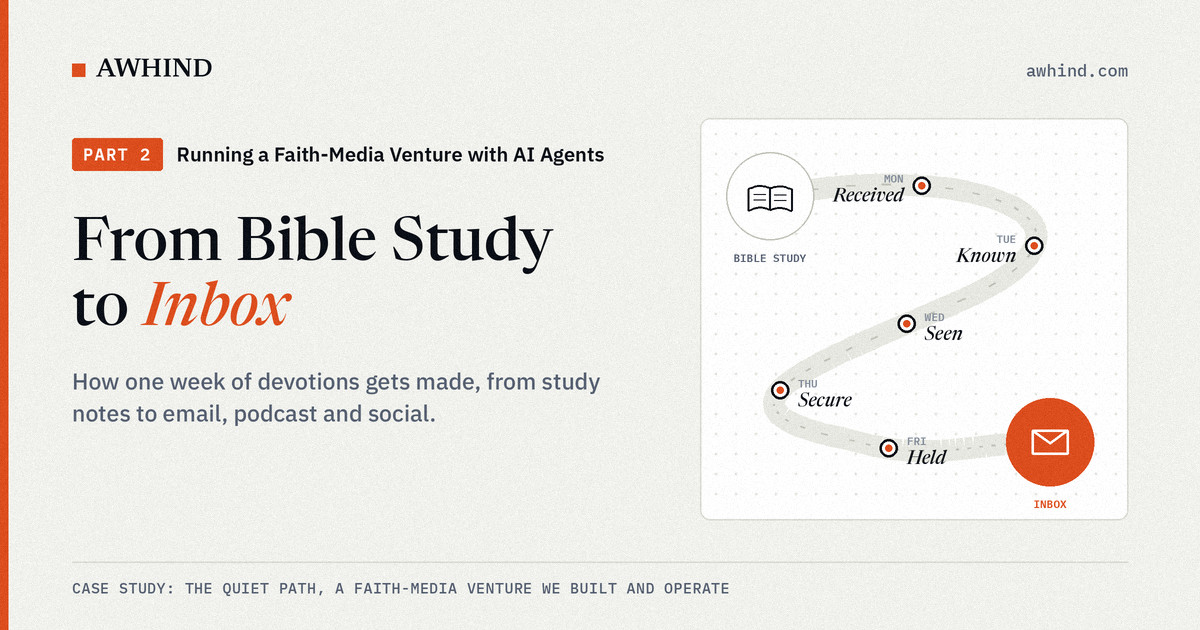
In Part 1, I introduced the team of AI agents behind The Quiet Path, the faith-media venture we built and operate at AWH. This time I want to follow the work itself: how one week of devotions moves from my Bible study to an email, a podcast episode and a set of social posts.
I'll use a real week as the example. From Monday, September 21 through Friday, September 25, The Quiet Path published a five-day series called You Belong: Five Days of Finding Your Identity in the Lord. Every step below happened that week.
It starts with my Bible study, not a prompt
Every series starts in my own time in Scripture. I spend about 20 hours a week on devotion content, and that is separate from my personal time with the Lord. Out of that study I build a framework for the week: the overall theme, broken down by day.
For You Belong, the question was what it means to belong to God when people leave us out. The five days became Received, Known, Seen, Secure and Held. The readings came from the Psalms: Psalm 27, Psalm 139, Psalm 56, Psalm 62 and, to close the week, Psalm 23. I prayerfully consider which psalm fits each day, and that choice is part of my framework, not Shepherd's.
This is the part I don't hand off. The spiritual direction, the themes and the shape of the week come from time in the Word. The agents don't set the direction. They carry it.
Shepherd drafts the five days
Shepherd, the agent that owns The Quiet Path, takes the framework and writes the week. Each day follows the same pattern: a title and subtitle, a reading, a focus verse, a short reflection, a few questions to pause on, and a closing prayer. The series also gets an introduction that runs with Day 1.
Shepherd writes two versions of each day. One is the written devotion for email. The other is a spoken script for the podcast, adjusted to be read aloud, with pause markers so I know where to slow down.
Then the drafts come back to me. I read them, revise them and send them back to Shepherd. That round trip keeps the words close to the study they came from.
The email goes out early in the morning
The written devotions publish on Substack, which sends them to subscribers by email. During You Belong, each day's post went out at 4:30 a.m. Pacific, Monday through Friday. The contrition series the week before went out at 6:30 a.m. Pacific. Either way, it's in the inbox before most people's day starts.
Each post is scheduled ahead of time, so nothing depends on someone being awake at 4:30. Our house rule for podcast links in email is to put them in the publication's email footer rather than hand-editing every post, so each daily email inherits them.
The podcast is my own voice
The podcast episodes are not generated voices. I record each day's spoken script as a voice memo and send it to Shepherd, who turns it into an episode and holds it until the scheduled time.
Each episode publishes at the same moment as that day's written devotion, 4:30 a.m. Pacific during You Belong. The audio and the podcast feed live on quietpathapp.com, and Apple Podcasts and Spotify pick up each new episode from that feed. The episode is also posted on Substack next to the written devotion. The You Belong episodes each run about four to five minutes. We did prepare a synthetic backup voice in case I couldn't record, but every published episode is me reading.
That choice was deliberate. A devotion someone listens to on a morning walk should come from a person who has actually prayed through it.
Mark turns the week into social posts, with rules
Mark, the marketing agent, takes the published devotions and builds social posts for Instagram at @quietpathapp, scheduled through Buffer. He works from a written set of house rules for how the podcast gets mentioned on each channel:
- Instagram: no Apple, Spotify or hub URLs in captions, because Instagram hides or breaks long link lists. The line is simply "Listen to The Quiet Path podcast, link in bio." At most one link goes in a caption, and on You Belong days that link is the day's Substack post.
- Artwork: on You Belong days, the image is that day's series graphic, never the generic green Quiet Path title card.
- Threads, Facebook and email: where links work, posts end with a short closer linking Apple Podcasts, Spotify and quietpathapp.com/podcast. Buffer holds a saved template for it so Mark isn't retyping links.
Timing matters too. During the contrition week, Mark scheduled the daily Instagram Stories for 7 p.m. Pacific, each with a "Read today's devotion" link to the Substack post. That kept the evening Stories from colliding with a separate app-feature campaign running at 10 a.m.
Where I approve
The rule from Part 1 still holds: anything that sends, spends or changes a live system comes to me first. In this workflow, that looks like:
- The framework. Nothing starts until I've done the study and set the week's direction.
- The drafts. I revise every draft, and nothing goes live until I tell Shepherd to go live. That's the whole sign-off, and it's enough.
- The audio. Nothing airs that I haven't read aloud myself.
- Social. I've given Mark a standing OK to post on Instagram without asking me post by post. That approval is written down, and it sits inside the rules above. New campaigns still come to me first.
- Anything new. New channels, new tools, spending or changes to the app still wait for me.
What a ministry can take from this
One week of study now produces five written devotions, five podcast episodes and a week of social posts. The agents didn't make the message. They made it possible to carry one message into every place our readers already are, on time, without me doing formatting at midnight.
If you're a church or small publisher, that's the shape I'd copy. Keep the theology and the voice with people. Let the agents handle drafting, formatting, scheduling and the channel-by-channel details. Write the rules down so everyone, human or agent, follows them the same way.
In Part 3, I'll get into the boring plumbing: the domain, email routing, hosting, the App Store and Buffer, all set up cheaply so it can be reproduced.
Let's talk
If you lead a ministry, run communications for a church or publish devotional content on a small team, I'd be glad to talk through how a workflow like this could fit your people and your voice. Email me at info@awhind.com.